Pyrenees · Hors catégorie · Via Ayros-Arbouix
Ride Hautacam from Argelès-Gazost: 13.7 km at 7.8% to 1,520 m
Hautacam is the Tour de France summit finish above Lourdes, and its numbers do not tell the whole story. The 13.7 km from Ayros-Arbouix average 7.8%, but the road never settles: short flatter bits are followed by kicks of more than 10%, so you change gear and stand up again and again. The hardest part is in the middle, after the hamlet of Saint-André, and the last kilometres open up into high pasture with cows on the road and a wide view over the valley.
Quick facts
- Distance
- 13.7 km
- Average grade
- 7.8%
- Max grade
- ~13%
- Elevation gain
- 1,064 m
- Summit
- 1,520 m
The experience
Hautacam is a small ski resort at about 1,500 m on the slopes above Argelès-Gazost and Lourdes, in the Hautes-Pyrénées. The climb used by the Tour de France leaves the valley road at Ayros-Arbouix, just outside Argelès-Gazost, at 458 m. From there pycol.fr, which measures the road on French national (IGN) elevation data, gives 13.7 km at 7.8% with 1,064 m of climbing to the Tour finish area at 1,520 m. A roadside sign at the start says 13 km at 8%. The road goes on past the finish for another 1.3 km at about 8% to the Col de Tramassel, at about 1,630 m, where there is a mountain hut and the ski lifts.
Section by section, using pycol's kilometre profile: the first four kilometres average 7–8%, with the first steep ramps already in the village and a steep stretch before the hamlet of Souin. Between Souin and Artalens the road eases, and kilometre 5 is only about 5%. Kilometre 6 is back to 7%, and then comes the hard part: after the hamlet of Saint-André, kilometres 7, 8 and 9 average 9%, 11% and 10%. French Wikipedia describes the road as irregular, with short ramps of more than 10% and up to 13% after the flatter bits. Climbfinder gives the steepest 100 m as 13.8% and counts 17 hairpins on the road to Tramassel. After an easier kilometre at about 6%, kilometres 11 and 12 are at 9% again, with a steep hairpin at the Arrioutou farm inn just after kilometre 11, and the last stretch to the finish is 7% and then 5%.
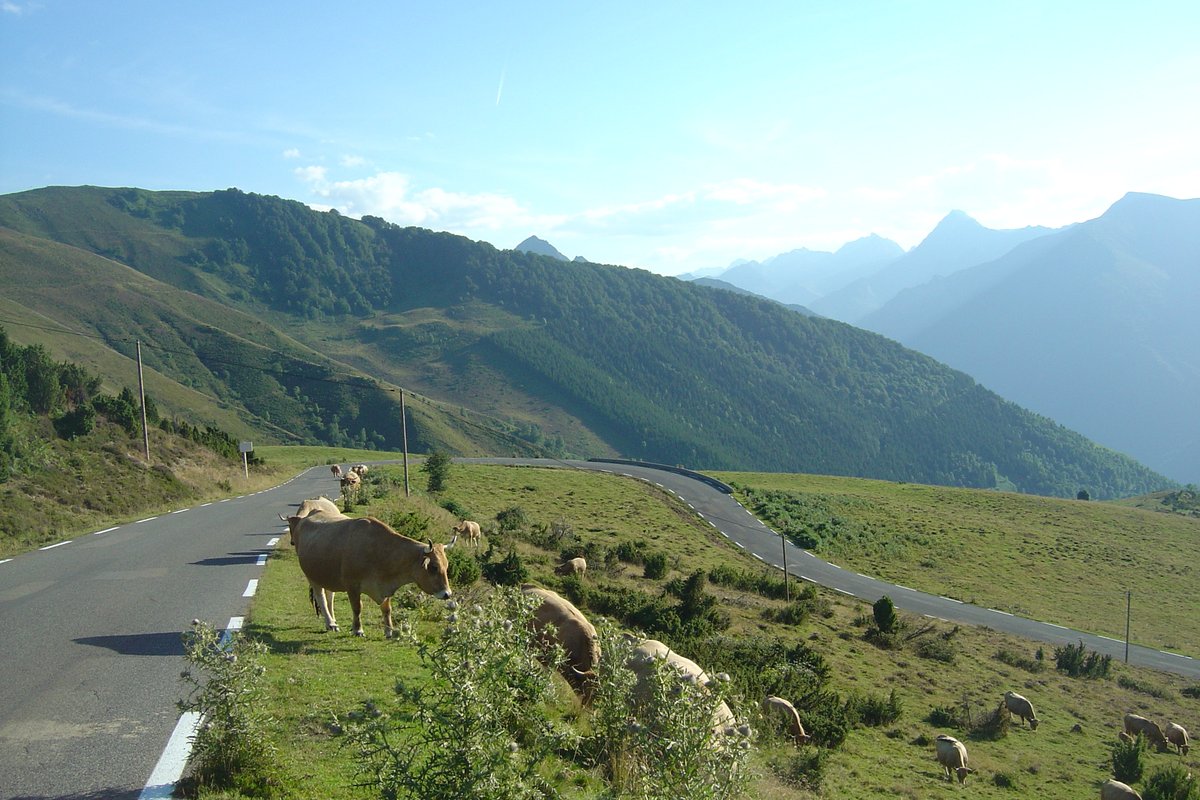
The top part is open mountain pasture. Horses and cattle graze freely and often stand on or next to the road, like the cows in the photo above, which was taken in the last kilometre. The finish is a wide, flat area at the ski resort rather than a pass, and there is not much there in summer, so it is the view back down over Argelès-Gazost and the valley that you come for. Along the road, pycol's map (based on OpenStreetMap) shows a water point at about km 1.5 and places to eat at about km 1.7, km 4.9 and the Auberge de l'Arrioutou at km 11.1. Opening times vary, so do not count on them outside the summer season.
The Tour de France has finished here seven times: in 1994, 1996, 2000, 2008, 2014, 2022 and 2025, always as an hors catégorie climb, the hardest category. The early finishes are tied to doping: Bjarne Riis won in 1996 on his way to winning the Tour and later admitted doping, Lance Armstrong took the yellow jersey here in 2000 and later lost all his Tour titles, and the first rider across the line in 2008, Leonardo Piepoli, was disqualified for doping a few months later. The recent winners were Vincenzo Nibali in 2014, Jonas Vingegaard in 2022 and Tadej Pogačar in 2025. On stage 12 in 2025, from Auch, Pogačar attacked with about 12 km to go and beat Vingegaard by more than two minutes. French television timed his climb at 35 minutes 21 seconds, an average of about 23 km/h.
Our time estimate (own calculation, rider and bike 80 kg in total, steady power, same model as our other guides, using pycol's kilometre profile): about 1 hour 41 minutes at 150 watts, 1 hour 24 minutes at 180 W and 1 hour 02 minutes at 250 W. At 180 W, the first six kilometres take about 34 minutes, the three steepest kilometres (7 to 9) about 23 minutes, and the rest to the finish about 28 minutes. So those three kilometres are only a fifth of the distance but take over a quarter of your time. If you carry on to the Col de Tramassel, add about 8 minutes at 180 W.
Here is our own angle on riding an irregular climb: where you spend extra effort matters. By our calculation, riding 40 watts harder (220 W instead of 180 W) on the three steepest kilometres saves about 4 minutes. The same 40 extra watts on three of the easier kilometres saves only about 2.5 minutes, because on the flatter bits more of the extra effort goes into pushing through the air. So if you have something extra, use it where the road is steepest and ease off a little on the flatter bits. But only push as hard as you could hold for a while, not as hard as you can: the kicks come again and again, all the way to kilometre 12. Gears by the same calculation, at 180 W: on 9% you ride at about 8.6 km/h, which is 56 pedal turns per minute on 34×28 and 64 on 34×32. On 11% it is 47 on 34×28 and 53 on 34×32, and on the 13% ramps only about 40 and 46. For most riders, that makes a 32 sprocket at the back the better choice here.
A good day plan: Hautacam and the Col du Soulor both start from Argelès-Gazost, so you can ride one in the morning and the other in the afternoon, or ride Hautacam on its own as a short, hard half-day. Start easy, because the first kilometres are already 7–8% and the hardest part only comes after kilometre 6. Bring full bottles, keep a little in reserve for kilometres 7 to 9 and the 9% kilometres near the Arrioutou hairpin, and then enjoy the last part through the pasture. The finish is about 7 °C colder than the valley by the usual rule of 6.5 °C per 1,000 m, so bring a jacket for the descent, which is steep and irregular too.
Pro tips
- Mistake: riding it like a steady climb: The 7.8% average hides constant changes between about 5% and 11%, with short ramps of 13%. Expect to shift gear often and to stand up on the kicks.
- Mistake: spending your effort on the flatter bits: By our calculation, extra effort saves almost twice as much time on the steepest kilometres as on the easier ones. Save it for kilometres 7 to 9.
- Mistake: too big gears: On 11–13% a 34×28 means only about 40–47 pedal turns per minute at 180 W. A 34×32 makes the kicks much easier to ride.
- Watch for animals on the road: Horses and cows graze freely on the top part of the climb and often stand on the road, also on the way down.
- Know where the finish is: The Tour finish at 1,520 m is not the top of the road. The Col de Tramassel is another 1.3 km at about 8%.
- Descend carefully: The way down has the same steep, irregular ramps and tight hairpins, and animals can be on the road around any corner.
Estimate your time up Hautacam
By our model, a 72 kg rider on an 8 kg bike holding 216 W (3 W/kg) needs about 1:11 for the 13.7 km and 1,064 m of Hautacam. Enter your weight, your bike's weight and the power you can hold for about an hour of climbing.
Estimated time: 1:10:52
More about the climb time calculator ·
Steady power, no wind, no stops, and the average grade of the whole climb. Steep ramps, flat sections and descents are only evened out roughly, so irregular climbs will be less accurate. Your values are saved only in this browser.
More climbs in France
Col du Soulor
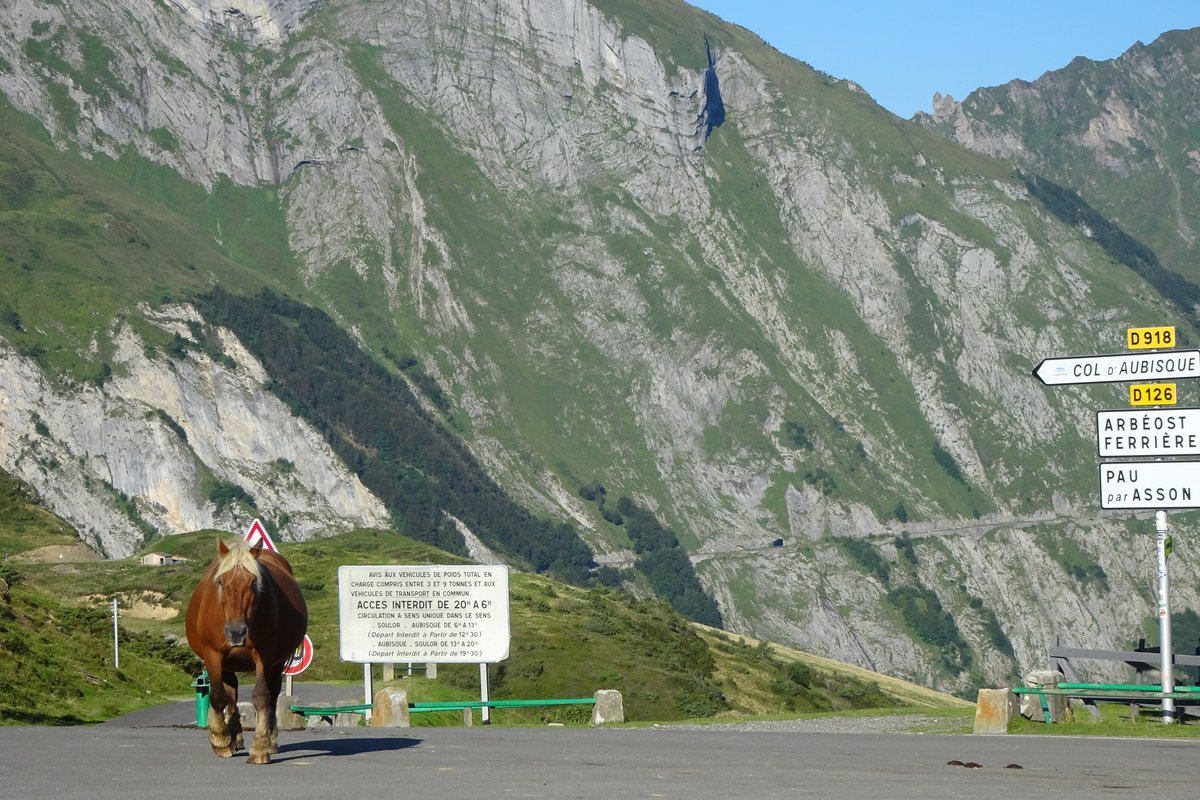
The gateway to the Aubisque — 19.5 km · 5.2% avg
Col du Tourmalet
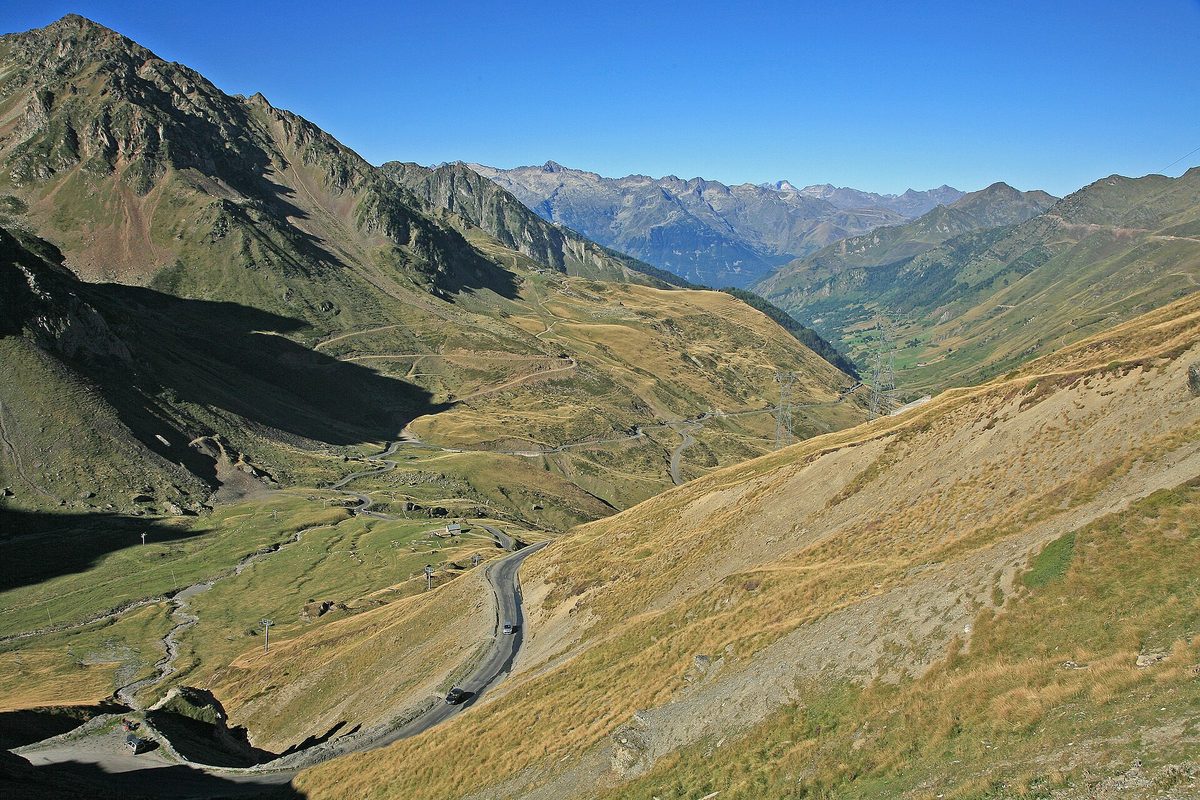
Giant of the Pyrenees — 19.0 km · 7.4% avg
Col d'Aubisque
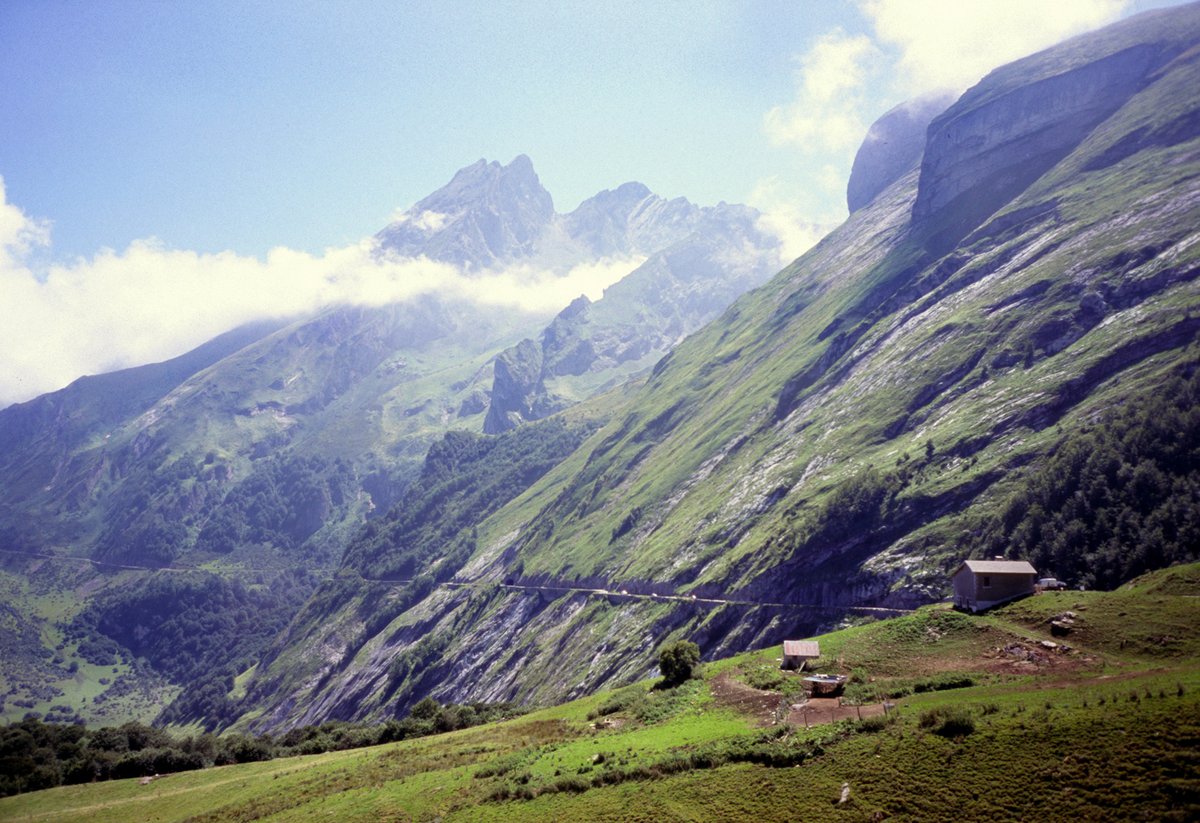
Balcony of the Pyrenees — 16.6 km · 7.2% avg
Also useful: Gearing for Mountain Climbs: Chainrings, Cassettes and Bike Setup for Alpe d'Huez, the Galibier and the Angliru
Also useful: How to Climb Long Mountain Climbs: Pacing, Effort and Fueling for Alpe d'Huez, Ventoux and the Galibier