Dolomites · Cima Coppi of the Giro · Via Selva di Cadore
Passo Giau from Selva di Cadore: 10.1 km at 9.1% to 2,236 m
The Passo Giau is a high pass in the Dolomites, on the SP638 road between Selva di Cadore and Cortina d'Ampezzo in the province of Belluno. From Selva di Cadore it climbs 922 m in 10.1 km at an average of 9.1%, through 29 numbered hairpins, to 2,236 m. What makes it hard is not one steep wall but the lack of any rest: the gradient stays between about 7% and 10% from bottom to top. The Giro d'Italia has crossed it eleven times since 1973, and it is the steepest pass of the Maratona dles Dolomites.
Quick facts
- Distance
- 10.1 km
- Average grade
- 9.1%
- Max grade
- ~14%
- Elevation gain
- 922 m
- Summit
- 2,236 m
The experience
The west side starts in Selva di Cadore at 1,314 m and follows the SP638 up the valley of the Codalonga stream to the pass. The Italian climb archive salite.ch gives 10.12 km at 9.1% with 922 m of climbing, from 1,314 m to 2,236 m, and Italian Wikipedia gives the same 10.1 km at 9.1%. The Giro d'Italia's own climb page gives 9.9 km at 9.3% with a maximum of 14%, and Climbfinder, which starts a little higher, gives 9.8 km at 9.5% with 923 m. Italian and English Wikipedia count 29 hairpins and three avalanche galleries on this side, and say the road over the Giau, unlike the Falzarego, is open to lorries and coaches. In winter, avalanches often block the open parts of the road.
Section by section, using salite.ch's profile: the first 1.6 km to the turn-off for Posalz are about 10% (8.3%, 9.9% and 10.0%). Then comes the only easier part of the climb, about 1.1 km at 7.3–7.6% past the bridge over the Codalonga. From 2.7 km it is about 10% again to a hairpin at 1,612 m, then 9.4–9.5% through the galleries and 8.9% to some huts at 1,800 m. A short stretch at 7.7% follows, and then the hardest part: about 1.4 km at 10.1–10.4% from 6.0 km up to the Rifugio Fedare at about 2,000 m. Above it the road is 8.6% for two kilometres, and the last 600 metres to the pass are 10.2% again. Climbfinder gives the steepest 100 m as 14.7%. In total, about 3 km of the climb are at 10% or more, and only about 1.7 km are under 8%.
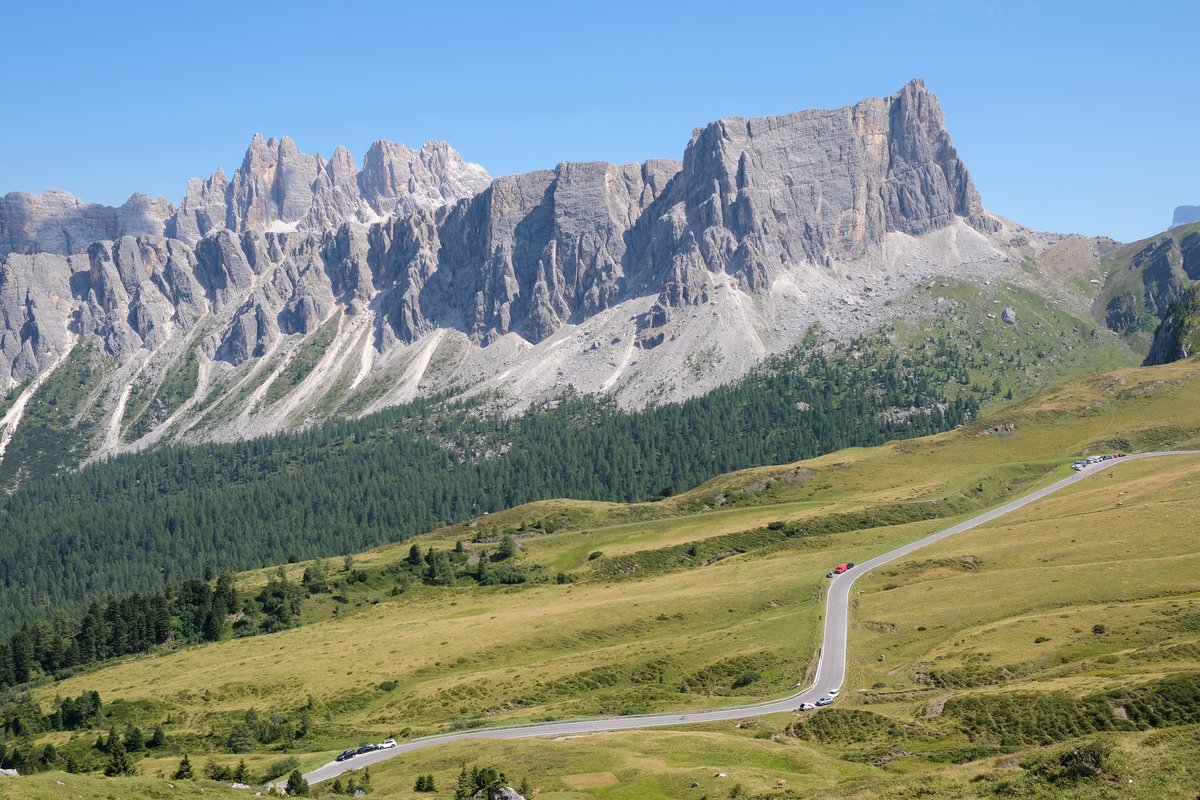
The landscape changes halfway up. Climbfinder reviewers describe the first half as a narrow valley in the trees beside the stream, where you hardly notice how much height you gain; around halfway the trees open up, the hairpins stack up across the meadows and the Dolomite walls appear ahead. The upper part is open and in full sun, and several reviewers note that there are few water fountains and nothing to eat on the way up until the huts near the top. Italian Wikipedia lists the Rifugio Fedare at 2,000 m, the Rifugio Da Aurelio at 2,175 m and the Rifugio Passo Giau at the pass itself, which sits in a wide pasture under the Nuvolau and the Ra Gusela rock tower, as in the photo above. Opening times vary, so do not count on them early or late in the season.
The Giro d'Italia first climbed the Giau in 1973, on the stage from Andalo to Auronzo di Cadore, when José Manuel Fuente was first over the top. That year it was also the Cima Coppi, the highest point of the race, and it was again in 2011, 2021 and 2026. In total the Giro has crossed it eleven times: 1973, 1989, 1992, 2007, 2008, 2011, 2012, 2016, 2021, 2023 and 2026, according to Italian and English Wikipedia; a planned crossing in 2013 was cancelled because of bad weather. The most famous day came on stage 16 of the 2021 Giro. Rain and snow forced the organisers to remove the Fedaia and the Pordoi, the Giau became the highest point of the race, and the race leader Egan Bernal attacked on it in the pink jersey, went over the top alone and descended 17 km to win in Cortina d'Ampezzo, 27 seconds ahead of Romain Bardet and Damiano Caruso. He went on to win that Giro. Not far to the east, the Zoncolan is the other great Giro climb of north-east Italy.
The most recent crossing was stage 19 of the 2026 Giro, from Feltre to Alleghe (Piani di Pezzè), a Dolomites stage with about 5,000 m of climbing. The Giau was again the Cima Coppi and was climbed from Selva di Cadore, and Giulio Ciccone was first over the top from the breakaway. Sepp Kuss won the stage alone at Piani di Pezzè. Since 1988 the Giau has also been part of the Maratona dles Dolomites, the big amateur race in Alta Badia, where English Wikipedia describes it as the steepest of the passes on the route.
Our time estimate for the rest of us (own calculation, rider and bike 80 kg in total, steady power, same model as our other guides, using salite.ch's profile): about 1 hour 25 minutes at 150 watts, 1 hour 12 minutes at 180 W and 52 minutes at 250 W. At 180 W that is an average of only 8.5 km/h, and the three kilometres at 10% or more take about 23 minutes of the 72. There is no single hard section to plan around here, so the whole climb is the hard section. Gears by the same calculation, at 180 W: on 9% you ride at about 8.6 km/h, which is 56 pedal turns per minute on 34×28 and 64 on 34×32. On 10% it is 51 on 34×28 and 58 on 34×32, on 12% 43 and 49, and on the short 14% ramps 37 and 43. If you have ridden the Gavia from Ponte di Legno, the feeling is similar, but on the Giau it lasts from the first hairpin to the last.
Our own angle is what 'no rest' means for gears and pacing, worked out with the same model. First, gears: at 180 W on a 34×28, more than half of the climb, about 39 of the 72 minutes, is ridden below 55 pedal turns a minute. With a 34×32 none of it is, because even the 10.4% part comes out at about 56. On a short climb you can grind a low cadence; for over an hour without a break it gets very tiring for the legs, so this is the climb where a 32 sprocket at the back pays off. Second, pacing: if you ride the first 3.3 km to the hairpin at 1,612 m at 210 W and then have to drop to 163 W for the rest, you do the same total work as at a steady 180 W but arrive about 2 minutes later (1 h 13 instead of 1 h 12). At 220 W for the first part and 156 W after, you lose about 3 minutes. Because the gradient hardly changes, there is no flat bit to recover on afterwards, so an early surge simply costs time. Pick an effort you are sure you can hold for over an hour, hold it to the top and only push if you still feel good above the Rifugio Fedare. Expect it to be about 6 °C cooler at the top than in Selva di Cadore (the usual drop of about 6.5 °C per 1,000 m), and bring a jacket for the 17 km descent to Cortina or back to Selva.
Pro tips
- Mistake: starting too hard: The first 1.6 km are already about 10% and there is no flat part later to recover. Starting at 210 W and fading to 163 W costs you about 2 minutes against a steady 180 W.
- Mistake: thinking the Rifugio Fedare is the top: The hut at about 2,000 m comes into view early, but after it there are still about 2.6 km and roughly 240 m to climb, and the last 600 m are 10%.
- Bring low gears: At 180 W on a 34×28 you spend more than half the climb below 55 pedal turns a minute. A 32 sprocket at the back keeps you above that all the way.
- Carry enough water: There are few fountains and nothing to buy until the huts near the top, and the upper half is in full sun. Start with two full bottles.
- Avoid summer weekends: Climbfinder reviewers report heavy traffic with many motorbikes in summer, especially at weekends. Early morning or May, June and September are quieter.
- Expect cold at the top: The pass is at 2,236 m and about 6 °C cooler than Selva di Cadore. Bring a jacket for the long descent.
Estimate your time up Passo Giau
By our model, a 72 kg rider on an 8 kg bike holding 216 W (3 W/kg) needs about 1:00 for the 10.1 km and 922 m of Passo Giau. Enter your weight, your bike's weight and the power you can hold for about an hour of climbing.
Estimated time: 1:00:02
More about the climb time calculator ·
Steady power, no wind, no stops, and the average grade of the whole climb. Steep ramps, flat sections and descents are only evened out roughly, so irregular climbs will be less accurate. Your values are saved only in this browser.
More climbs in Italy
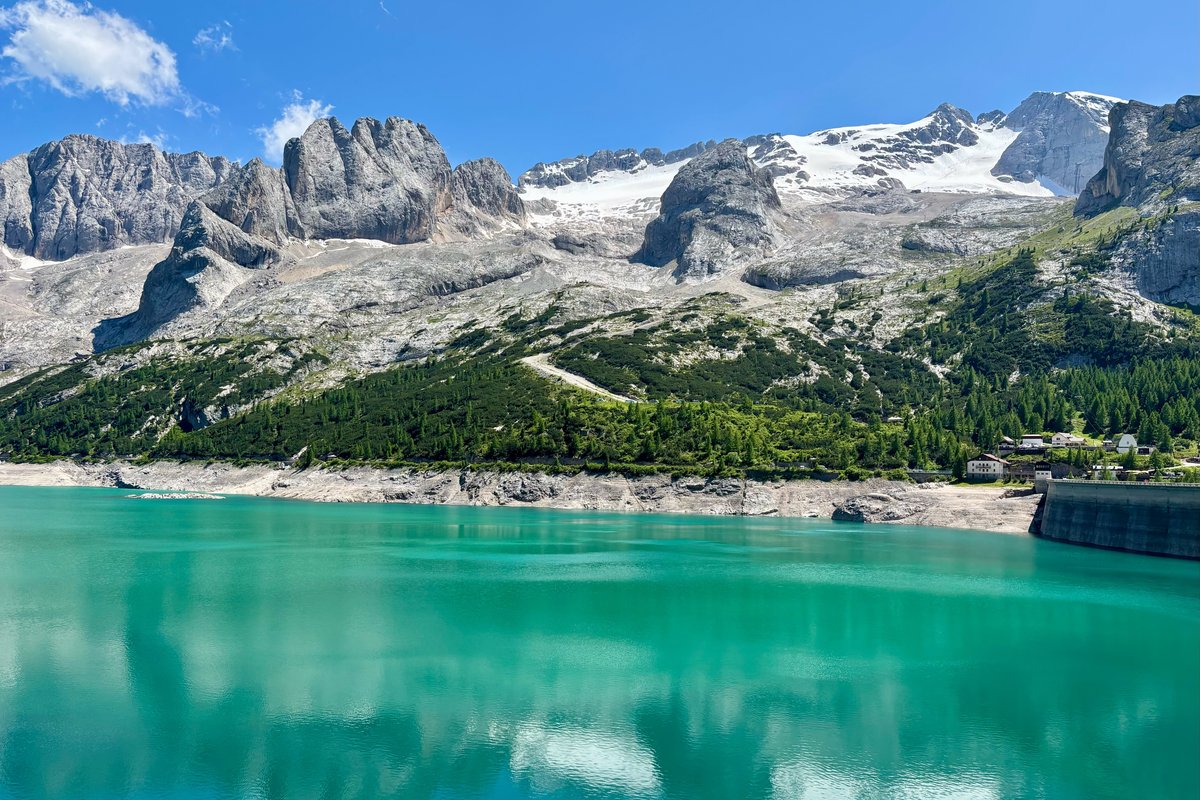
Passo Fedaia
The Marmolada climb: nine gentle kilometres, then the long straight after Malga Ciapela and five kilometres at about 11% — 14.0 km · 7.5% avg
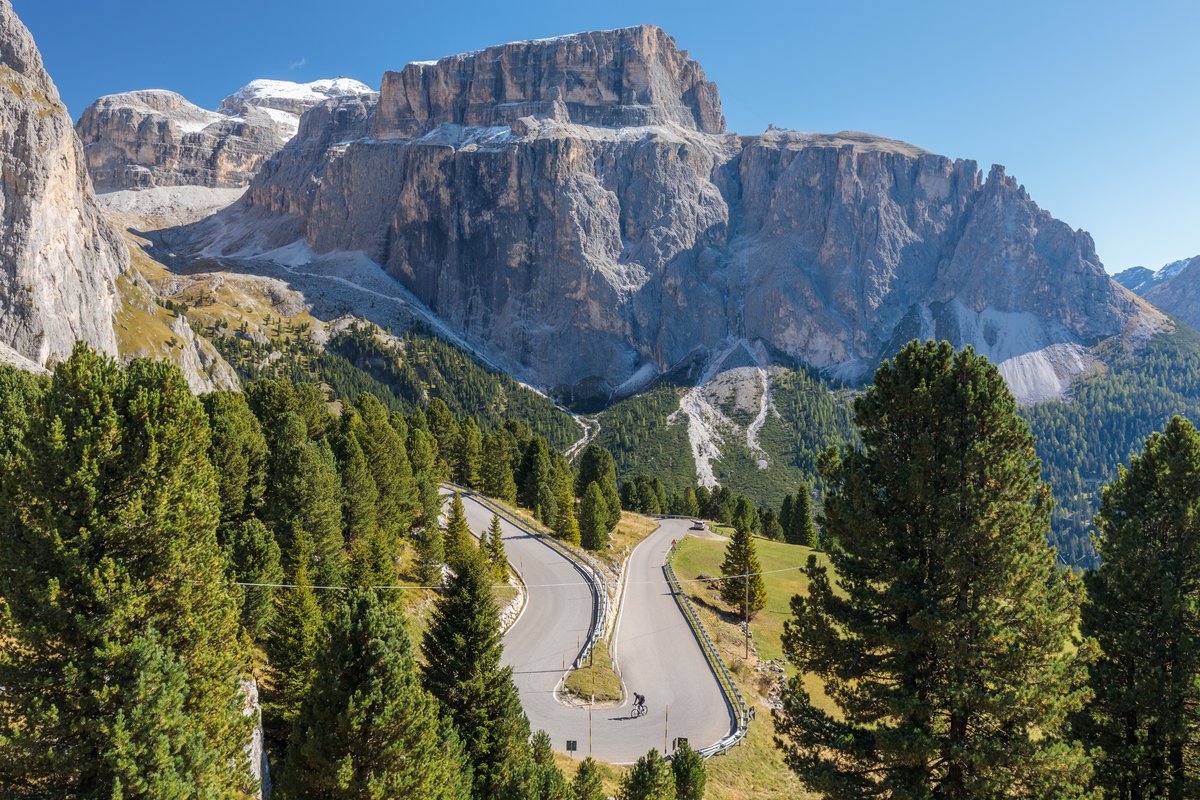
Passo Sella
The Canazei side of the Sellaronda's hard first climb, shared with the Pordoi until the left turn — 11.2 km · 7.1% avg
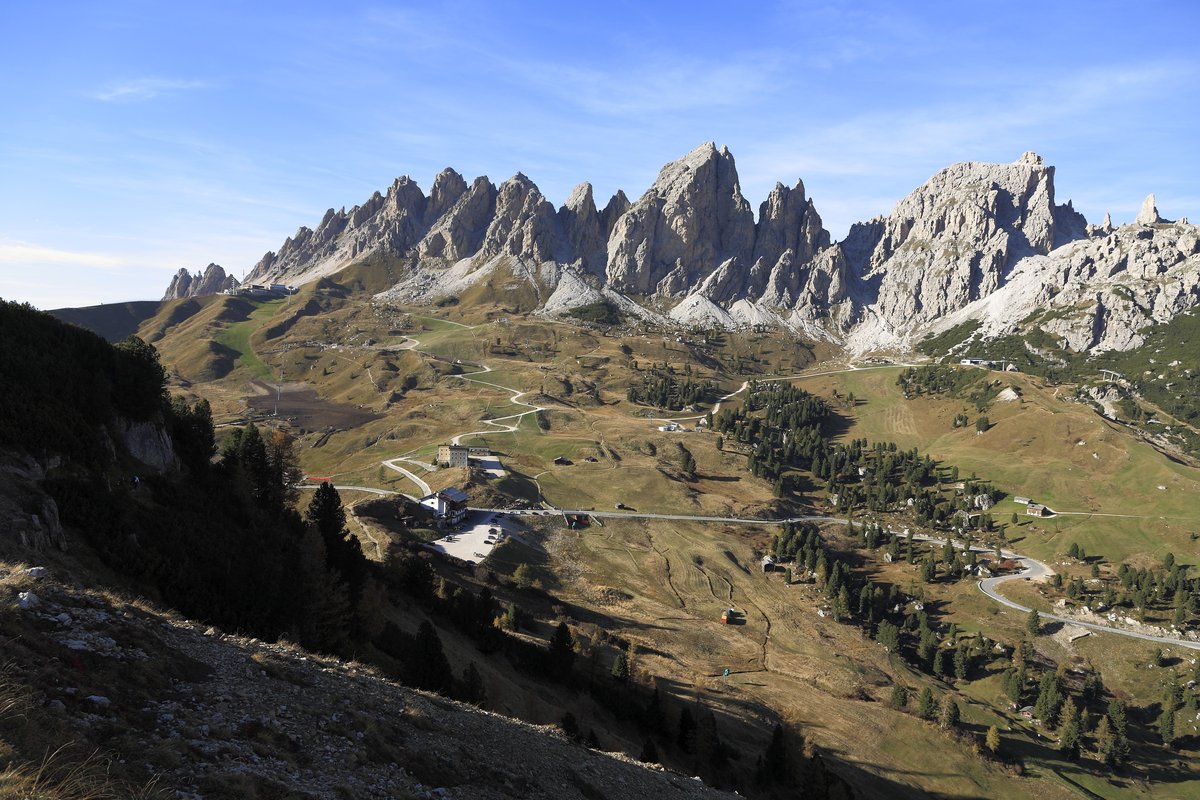
Passo Gardena
The steady, scenic Corvara side under the Cir spires, the longest climb of an anti-clockwise Sellaronda — 9.1 km · 6.6% avg
Also useful: Gearing for Mountain Climbs: Chainrings, Cassettes and Bike Setup for Alpe d'Huez, the Galibier and the Angliru
Also useful: How to Climb Long Mountain Climbs: Pacing, Effort and Fueling for Alpe d'Huez, Ventoux and the Galibier