Dolomites · Sellaronda and Maratona · Via Canazei
Passo Sella from Canazei: 11.2 km at 7.1% to 2,243 m
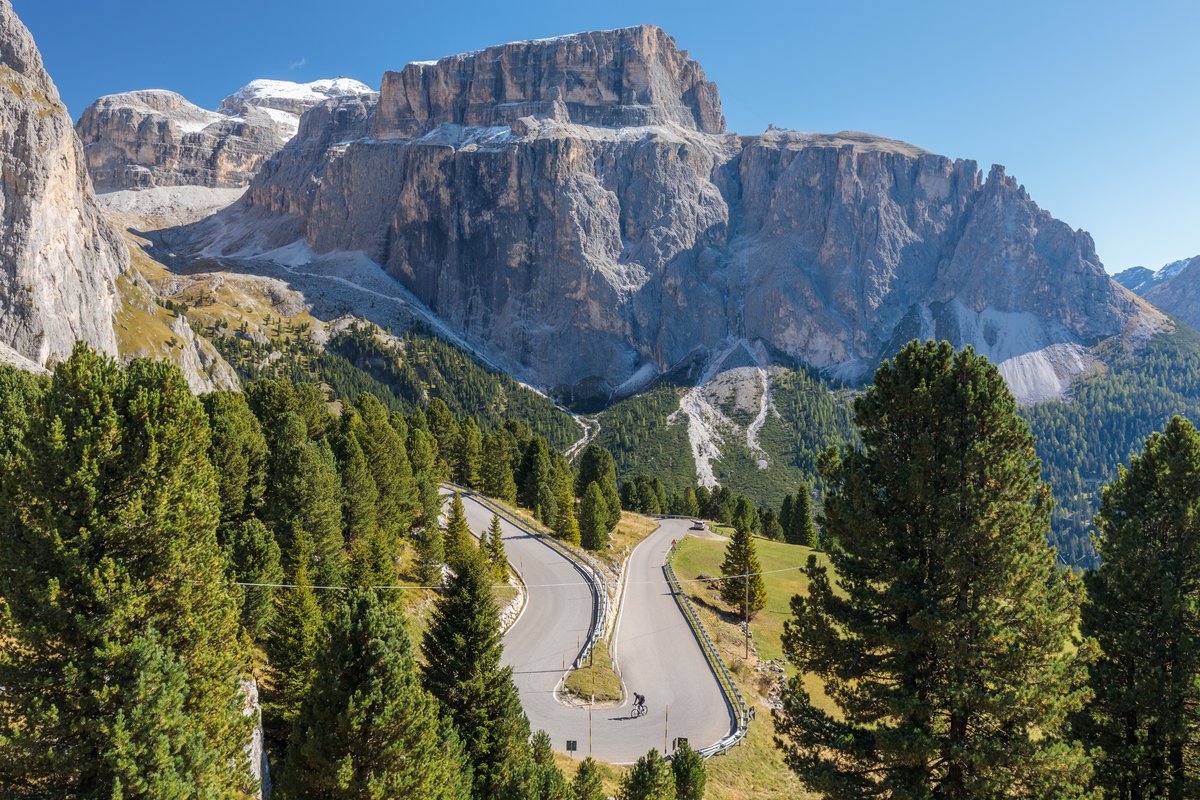
The Passo Sella (German Sellajoch, Ladin Jëuf de Sela) sits between the Sella massif and the Sassolungo group, linking Canazei in Val di Fassa with Selva di Val Gardena. From Canazei the climb is about 11.2 km at 7.1% with 794 m of climbing to the road crest at about 2,243 m. The first half shares the SS48 with the Passo Pordoi; at the fork you turn left onto the SS242 and the gradient hardens. It is the most popular side according to Climbfinder, the hard first climb of a clockwise Sellaronda, and the third of seven passes in the Maratona dles Dolomites. The Giro d'Italia has crossed it 18 times since 1940, four of them as the Cima Coppi.
Quick facts
- Distance
- 11.2 km
- Average grade
- 7.1%
- Max grade
- ~11%
- Elevation gain
- 794 m
- Summit
- 2,243 m
The experience
The south side starts in Canazei at about 1,456 m. Climbfinder gives 11.2 km at 7.1% with 794 m of climbing to a top at 2,243 m, on the SS48 and then the SS242, and counts 31 hairpins. CyclingCols lists 11.0 km at 7.2% with 797 m to 2,244 m and a maximum of 11%. The Italian climb archive salite.ch measures 11.4 km at 6.6% with 758 m, finishing at a lower point on the saddle (2,214 m) rather than the road crest. Altigraphs measures 11.2 km at 7.0% with 790 m to about 2,241 m. English Wikipedia quotes the pass itself at 2,218 m; German Wikipedia notes that the often-published 2,240–2,244 m figures are the road crest a little east of the watershed.
Section by section, using Altigraphs' kilometre profile (the clearest published breakdown of this side): the first kilometre out of Canazei is about 5.1%, then a punchy kilometre at 9.9%, a breather at 4.1%, and two steadier kilometres at 5.9% and 6.2% up toward the Pordoi junction. After the left turn the climb sits mostly between 6.6% and 9.3%: 7.7%, 6.6%, then a hard kilometre at 9.3%, then 7.6%, 8.3% and 7.4% into the top, with a short easing at the end. Climbfinder gives the steepest 100 m as 11.1%. The average of about 7% is real, but the second half is clearly harder than the shared Pordoi road.
The first kilometres climb through woods and numbered hairpins on the wide Pordoi road. Climbfinder reviewers describe good asphalt, a busy stretch shared with cars and motorbikes later in the morning, and then thinning trees after the junction with open views of the Sella walls and, at the top, the Sassolungo. Several reviews warn that summer traffic can be heavy (coaches and motorbikes), that early starts are much quieter, and that the narrow summit often jams with people stopping for photos. There are cafés and a hotel around the pass; fill bottles in Canazei before you leave. The hairpin numbering is confusing: the shared section continues the Pordoi count, then after the fork the Sella numbers run down from about 10 to 1.
The Giro d'Italia first crossed the Sella on 5 June 1940, on the stage from Pieve di Cadore to Ortisei, when Gino Bartali was first over the top after the long day with Fausto Coppi. Coppi led over it in 1952 and 1953. German Wikipedia's race table lists 18 crossings from 1940 to 2024: among them Laurent Fignon in 1984 on a clockwise Sellaronda stage, Marco Pantani taking the pink jersey over the south side as Cima Coppi in 1998, Gilberto Simoni in 2000, José Rujano in 2005, David López in 2016, and Giulio Pellizzari as Cima Coppi from the north in 2024 after the Umbrail was removed from the previous stage. It has been the Cima Coppi four times (1969, 1976, 1998 and 2024).
Every summer the Maratona dles Dolomites climbs this side as the third of its seven passes, right after the Passo Pordoi. On a clockwise Sellaronda from Canazei it is the first climb, and Climbfinder reviewers often say that direction is the harder way round precisely because of this Canazei side. The shorter north side from Plan de Gralba is what you ride on an anti-clockwise loop, or as the last climb if you started elsewhere.
Our time estimate for the rest of us (own calculation, rider and bike 80 kg in total, steady power and no wind, same model as our other guides, using Altigraphs' kilometre profile of 11.2 km): about 1 hour 16 minutes at 150 watts, 1 hour 4 minutes at 180 W and 47 minutes at 250 W. At 180 W that is an average of about 10.6 km/h, close to Climbfinder's table (1:01 at 11 km/h). Gears by the same calculation, at 180 W: on the average ~7.1% you ride at about 10.5 km/h, which is roughly 69 pedal turns per minute on 34×28 and 78 on 34×32. On the 9.9% and 9.3% kilometres it is about 51–54 on 34×28 and 59–62 on 34×32. With a 34×28 you spend about 21 of the 64 minutes below 60 turns a minute; with a 34×32 that falls to about 8 minutes. A compact with a 28 is usable; a 32 is more comfortable on the hard kilometres after the junction.
Our own angle is the junction trap. Using the same model at 180 W, the first 5.7 km up to about the Pordoi fork (average about 6.4%) take roughly 30 minutes. The 5.6 km after the left turn (average about 7.7%) take about 34 minutes — so just under half the distance takes more than half the time. If you fade to about 160 W on that second half, you lose about 4 minutes compared with holding 180 W. A 20 km/h headwind on the open upper half costs about 7 minutes at 180 W. So do not empty the tank on the shared Pordoi road: keep something for the left turn, accept a steadier pace on the early 9.9% kilometre, and check the wind for the pass. Expect it to be about 5 °C cooler at the top than in Canazei on a standard lapse rate, more with wind, and bring a jacket for the descent toward Val Gardena.
Pro tips
- Mistake: emptying the tank before the junction: The first half is the shared Pordoi road. After the left turn the average rises to about 7.7% and that half takes longer — fading to 160 W there costs about 4 minutes.
- Mistake: a 25 sprocket only: At 180 W on the 9–10% kilometres a 34×25 is only about 46–48 pedal turns a minute. A 28 is usable; a 32 keeps you turning through the hard blocks.
- Go early: Climbfinder reviewers and summer traffic votes point to heavy cars, coaches and motorbikes later in the morning. Early starts are much quieter.
- Fill bottles in Canazei: There are cafés and a hotel at the pass, but the reliable place to fill up before the climb is in the village.
- Watch the hairpin numbers: On the shared section the numbers follow the Pordoi count; after the fork the Sella numbers run down toward the top. You are not lost.
- Bring a jacket: The road crest is about 2,243 m and roughly 5 °C cooler than Canazei. The top is open and often windy; you will want a layer for the descent.
Estimate your time up Passo Sella
By our model, a 72 kg rider on an 8 kg bike holding 216 W (3 W/kg) needs about 54 min for the 11.2 km and 794 m of Passo Sella. Enter your weight, your bike's weight and the power you can hold for about an hour of climbing.
Estimated time: 53:44
More about the climb time calculator ·
Steady power, no wind, no stops, and the average grade of the whole climb. Steep ramps, flat sections and descents are only evened out roughly, so irregular climbs will be less accurate. Your values are saved only in this browser.
More climbs in Italy
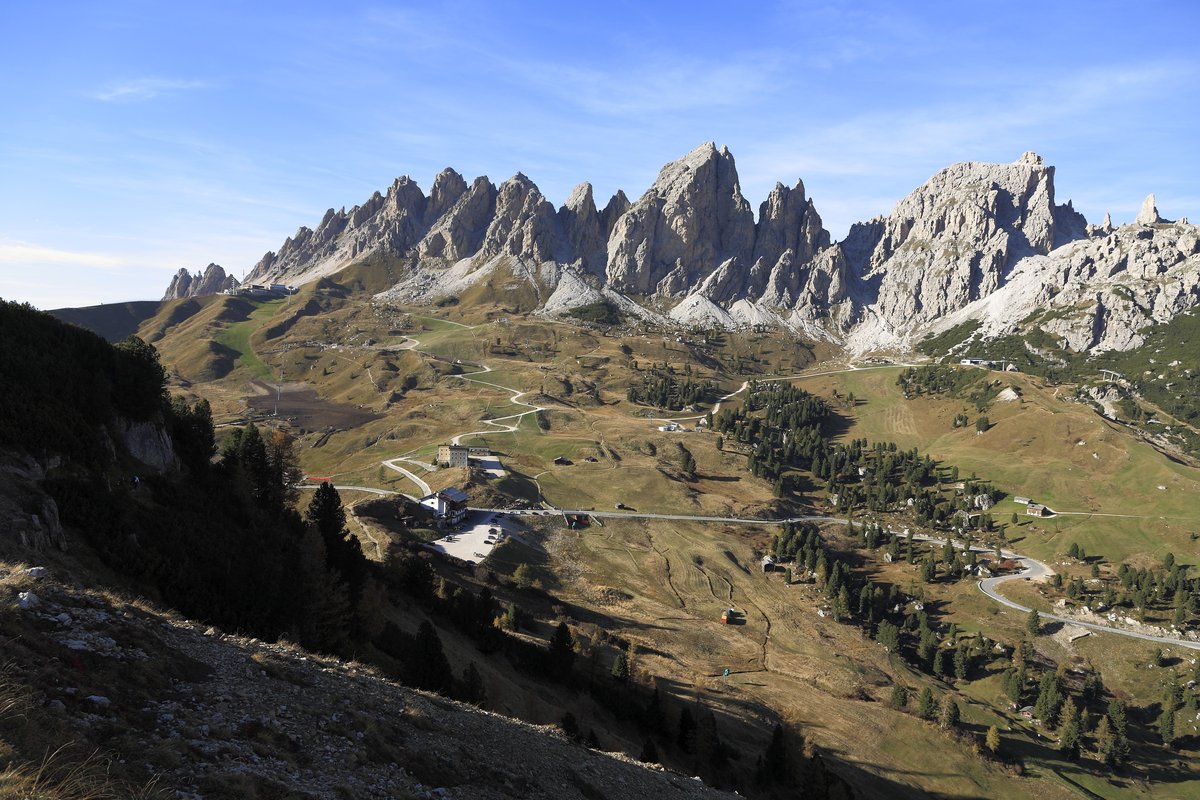
Passo Gardena
The steady, scenic Corvara side under the Cir spires, the longest climb of an anti-clockwise Sellaronda — 9.1 km · 6.6% avg
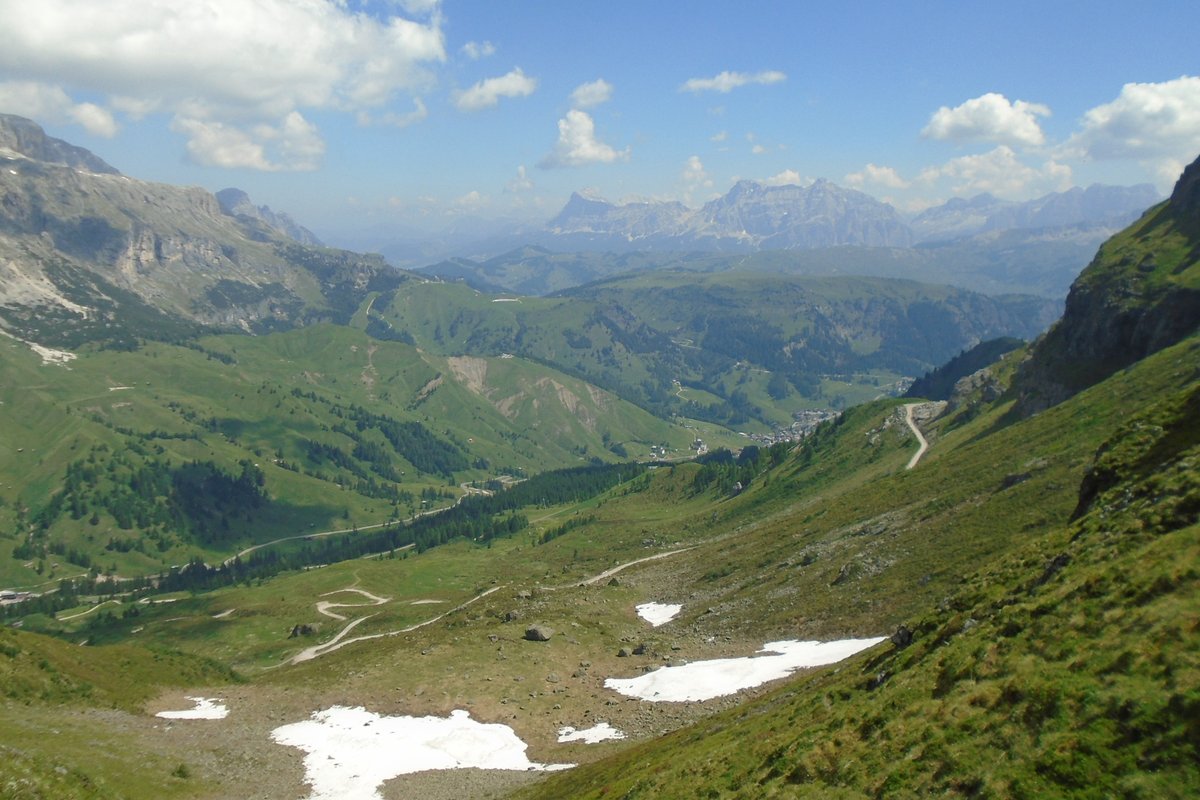
Passo Pordoi
The steady Dolomites classic with 33 hairpins, Coppi's monument and an exposed, windy top — 9.4 km · 6.8% avg
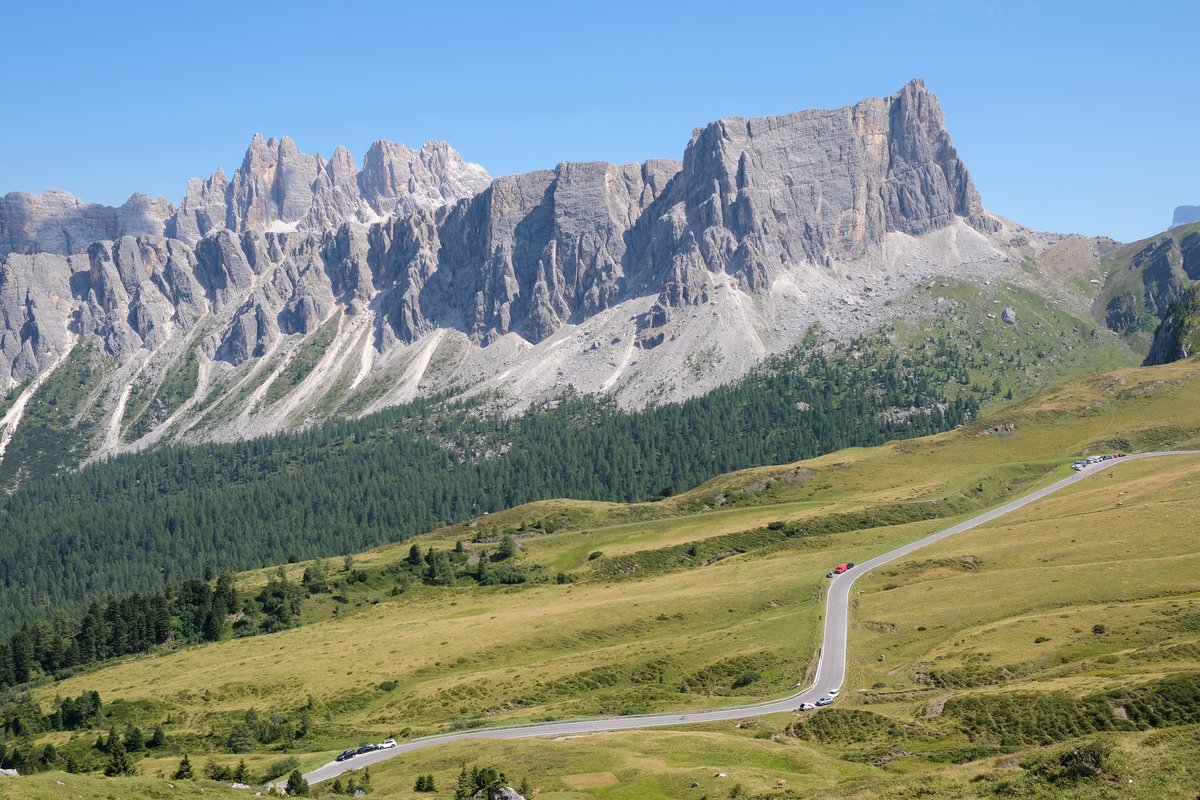
Passo Giau
The Dolomites pass with 29 hairpins and no real rest from bottom to top — 10.1 km · 9.1% avg
Also useful: Gearing for Mountain Climbs: Chainrings, Cassettes and Bike Setup for Alpe d'Huez, the Galibier and the Angliru
Also useful: How to Climb Long Mountain Climbs: Pacing, Effort and Fueling for Alpe d'Huez, Ventoux and the Galibier