Dolomites · Maratona dles Dolomites and Sellaronda · Via Arabba
Passo Pordoi from Arabba: 9.4 km at 6.8% to 2,239 m
The Passo Pordoi is one of the great Dolomite passes, on the SR48 'Great Dolomites Road' between Arabba in Veneto and Canazei in Trentino, under the Sella group. From Arabba it climbs 637 m in 9.4 km at an average of 6.8%, through 33 hairpins, to 2,239 m. It is never really steep, which is exactly its character: a long, even climb where you can find a rhythm and hold it. The Giro d'Italia has crossed it 41 times since 1940, and there is a monument to Fausto Coppi at the top. It is also the second climb of the Maratona dles Dolomites and part of the Sellaronda loop.
Quick facts
- Distance
- 9.4 km
- Average grade
- 6.8%
- Max grade
- ~10%
- Elevation gain
- 637 m
- Summit
- 2,239 m
The experience
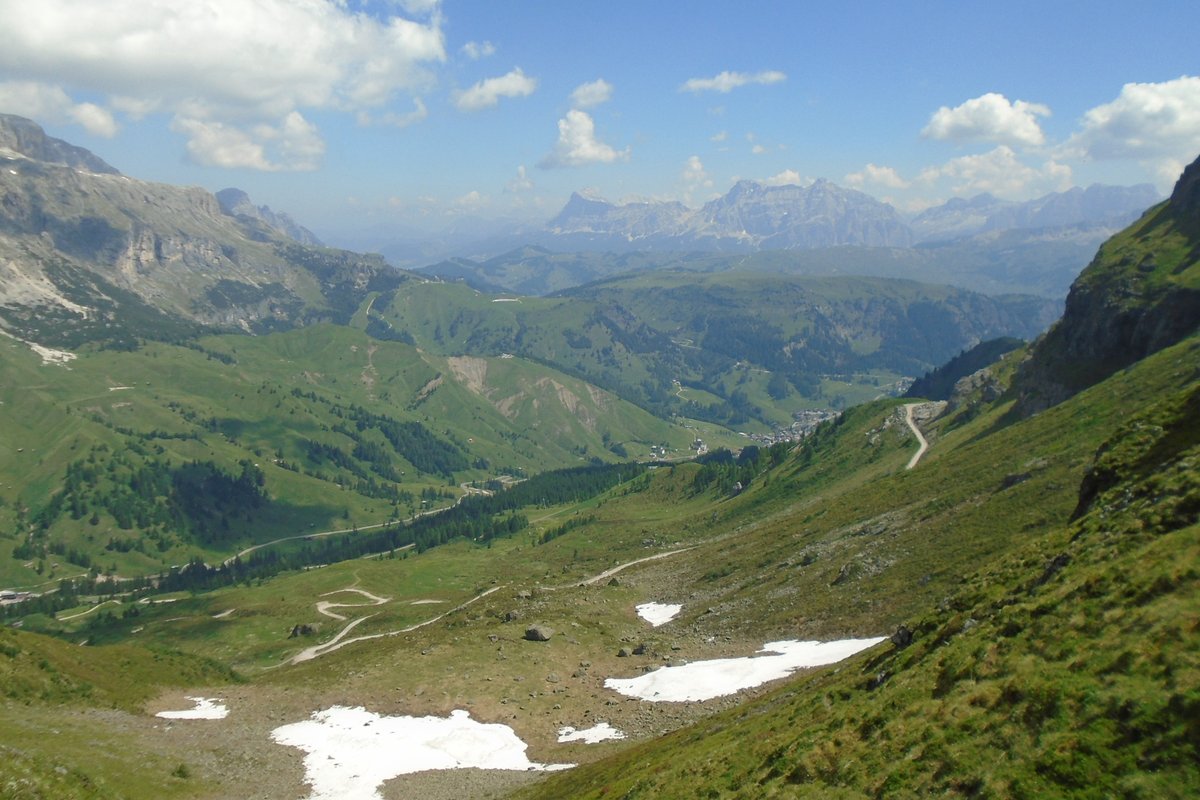
The east side starts in the ski village of Arabba at about 1,602 m. The Italian climb archive salite.ch and English Wikipedia both give 9.4 km at 6.8% with 637 m of climbing to the pass at 2,239 m. Climbfinder, which starts and stops at slightly different points, gives 9.2 km at 7% with 644 m and puts the top at 2,240 m. Climbfinder counts 33 hairpins on this side, and reviewers note that they are numbered from Arabba, that there are two short tunnels and kilometre signs to the top, and that the last numbered hairpin still comes a little way before the pass.
Section by section, using salite.ch's profile: the first 1.4 km out of Arabba alternate between about 5% and 7.5%. Then comes the steepest part of the climb, about 650 m at 9.7% up to 1,751 m. After that the road eases to 5.6% for almost a kilometre past some huts at 1,804 m, and from about 3 km it settles into 7–8% up to a hairpin at 1,900 m. The rest is 6–7.7% with one easier stretch at 5.2% between 2,058 m and 2,100 m, and the last 1.5 km are a steady 6.4%. Climbfinder gives the steepest 100 m as 10.4%. Apart from that one short ramp, almost the whole climb sits between 5% and 8%.
The road leaves the trees early on this side. The Dolomites cycling site cyclingdolomites.com describes the first 3.5 km as four groups of hairpins with long straights in between, then 22 hairpins in the next 4.5 km, about one every 200 metres, across open pasture. Climbfinder reviewers describe it as open almost all the way, with views of the Sella group on the right and the Marmolada in the distance, and with a very even gradient that makes it easy to find a rhythm. The flip side of being open is the wind: cyclingdolomites.com and epicroadrides.com both warn that the top part is exposed, and that a headwind there changes the whole feel of the climb. There is a water fountain by the church in Arabba at the start, and cafés, hotels and shops at the pass.
The Pordoi has a long history with the Giro d'Italia. The race first crossed it on 5 June 1940, from Arabba, on the stage from Pieve di Cadore to Ortisei, when Gino Bartali was first over the top and the young Fausto Coppi, according to the Giro's own history page, struggled on the climb before Bartali waited for him and got him going again. Coppi went on to win that Giro, and later led over the Pordoi five times (1947, 1948, 1949, 1952 and 1954). The Giro's list and Italian Wikipedia show 41 crossings in 36 editions from 1940 to 2022, four of them as stage finishes (1990, 1991, 1996 and 2001), and the pass has been the Cima Coppi, the highest point of the race, at least 13 times. A monument to Coppi stands at the top.
Not every Giro has used this side. From Arabba, the race climbed the Pordoi in the Coppi years, in 1983 and 1984 when Laurent Fignon took the pink jersey from Francesco Moser on the stage to Arabba, in 2008 when Emanuele Sella was first over the top straight out of the stage start in Arabba, and most recently in 2016 with Damiano Cunego. The last crossing, in 2022 with Alessandro Covi, came from Canazei. Every summer the amateur riders of the Maratona dles Dolomites climb this side too, as the second of the race's seven passes. If you want the opposite kind of Dolomites climb, the Passo Giau is less than 20 km away as the crow flies: similar height, but at 9.1% with no easy sections.
Our time estimate for the rest of us (own calculation, rider and bike 80 kg in total, steady power and no wind, same model as our other guides, using salite.ch's profile): about 1 hour 1 minute at 150 watts, 52 minutes at 180 W and 38 minutes at 250 W. At 180 W that is an average of about 10.9 km/h, which matches Climbfinder's own table (50 minutes at 11 km/h). Gears by the same calculation, at 180 W: on the average 6.8% you ride at about 10.9 km/h, which is 63 pedal turns per minute on 34×25, 71 on 34×28 and 81 on 34×32. On the 9.7% ramp it is 47, 52 and 60. With a 34×28 you spend only about 5 of the 52 minutes below 60 turns a minute, and all of that is on that one ramp. This is one of the few big Dolomite passes where a normal compact chainset with a 28 sprocket is plenty for most riders.
Our own angle is the wind on the open top. Using the same model, we looked at the last 2.9 km from about 2,058 m, where the road runs across open slopes. With no wind they take about 15 minutes at 180 W. Into a 10 km/h headwind they take about 1½ minutes longer, into 20 km/h about 3½ minutes longer and into 30 km/h about 6 minutes longer. To hold the same time into a 20 km/h headwind you would need about 230 W instead of 180 W, which most people cannot hold for a quarter of an hour at the end of a climb. A tailwind of the same strength only saves about 1 minute, because at climbing speed the wind helps much less than it hurts. So check the wind forecast for the pass, not the valley. On a windy day, keep something in reserve for the last 3 km, sit behind another rider on that stretch if you can, and accept a slower time rather than chasing your normal pace. Expect it to be about 4 °C cooler at the top than in Arabba (the usual drop of about 6.5 °C per 1,000 m), more with wind, and bring a jacket for the descent.
Pro tips
- Mistake: racing the 9.7% ramp: The steepest part comes early, about 650 m at 9.7% after 1.4 km. Ride it calmly; after it the climb eases and stays steady for the rest of the way.
- Mistake: ignoring the wind: The last 3 km are open. A 20 km/h headwind there costs about 3½ minutes at 180 W, so save some energy for it on a windy day.
- A compact is enough: At 180 W a 34×28 keeps you above 60 pedal turns a minute for all but about 5 minutes of the climb. A 32 sprocket makes it easier still.
- Fill up in Arabba: There is a water fountain by the church in Arabba at the start, and cafés at the pass, but not much in between.
- Go early: Climbfinder reviewers mention a lot of cars, camper vans and motorbikes in summer, especially later in the morning. Early starts are much quieter.
- Bring a jacket: The pass is at 2,239 m and about 4 °C cooler than Arabba, and the top is exposed to wind. You will want a layer for the descent.
Estimate your time up Passo Pordoi
By our model, a 72 kg rider on an 8 kg bike holding 216 W (3 W/kg) needs about 43 min for the 9.4 km and 637 m of Passo Pordoi. Enter your weight, your bike's weight and the power you can hold for about an hour of climbing.
Estimated time: 43:29
More about the climb time calculator ·
Steady power, no wind, no stops, and the average grade of the whole climb. Steep ramps, flat sections and descents are only evened out roughly, so irregular climbs will be less accurate. Your values are saved only in this browser.
More climbs in Italy
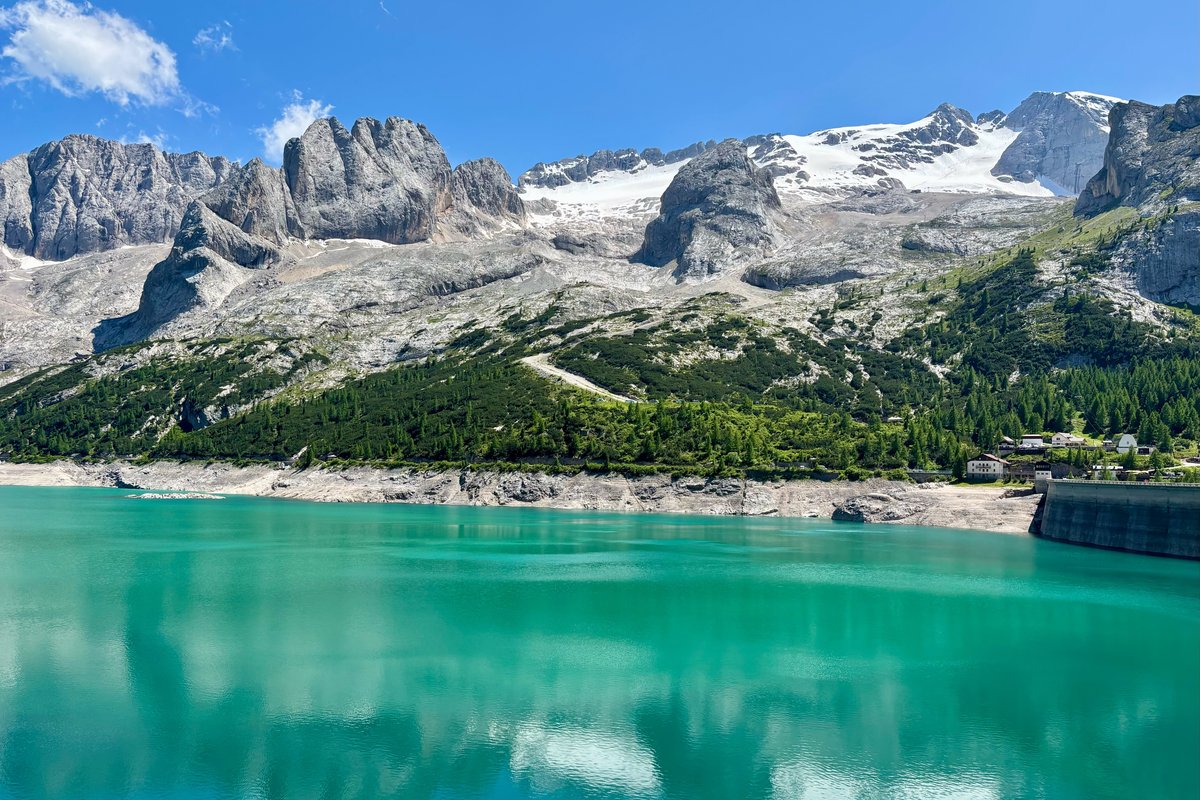
Passo Fedaia
The Marmolada climb: nine gentle kilometres, then the long straight after Malga Ciapela and five kilometres at about 11% — 14.0 km · 7.5% avg
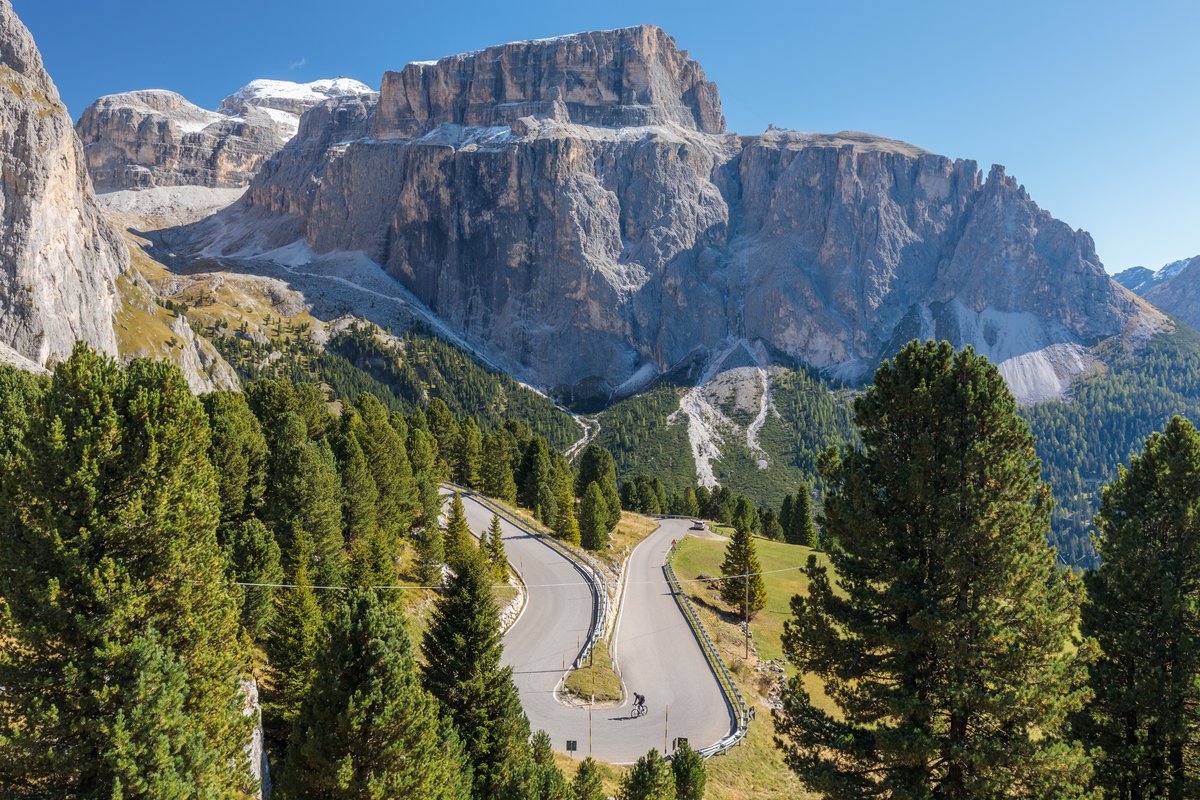
Passo Sella
The Canazei side of the Sellaronda's hard first climb, shared with the Pordoi until the left turn — 11.2 km · 7.1% avg
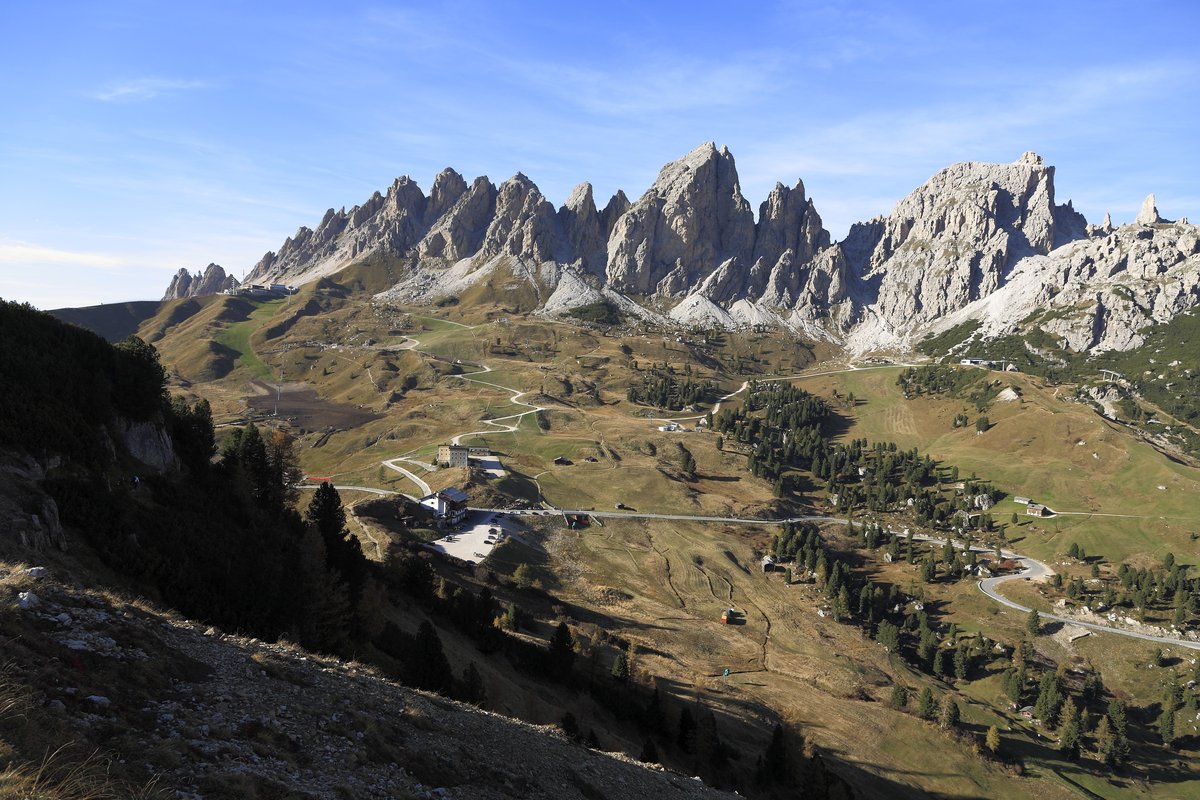
Passo Gardena
The steady, scenic Corvara side under the Cir spires, the longest climb of an anti-clockwise Sellaronda — 9.1 km · 6.6% avg
Also useful: Gearing for Mountain Climbs: Chainrings, Cassettes and Bike Setup for Alpe d'Huez, the Galibier and the Angliru
Also useful: How to Climb Long Mountain Climbs: Pacing, Effort and Fueling for Alpe d'Huez, Ventoux and the Galibier